English
 Español

The reason a shot blasting machine is able to perform both cleaning and hardening at the same time is because when high-velocity pellets strike a metal surface, two distinct physical effects occur: macroscopic removal of contaminants (cleaning) and microscopic optimization of the structural integrity of the material (hardening). Although both effects are caused by the same basic process, their mechanisms of action are significantly different.
I. Basic principle: Kinetic effect of high-velocity shot
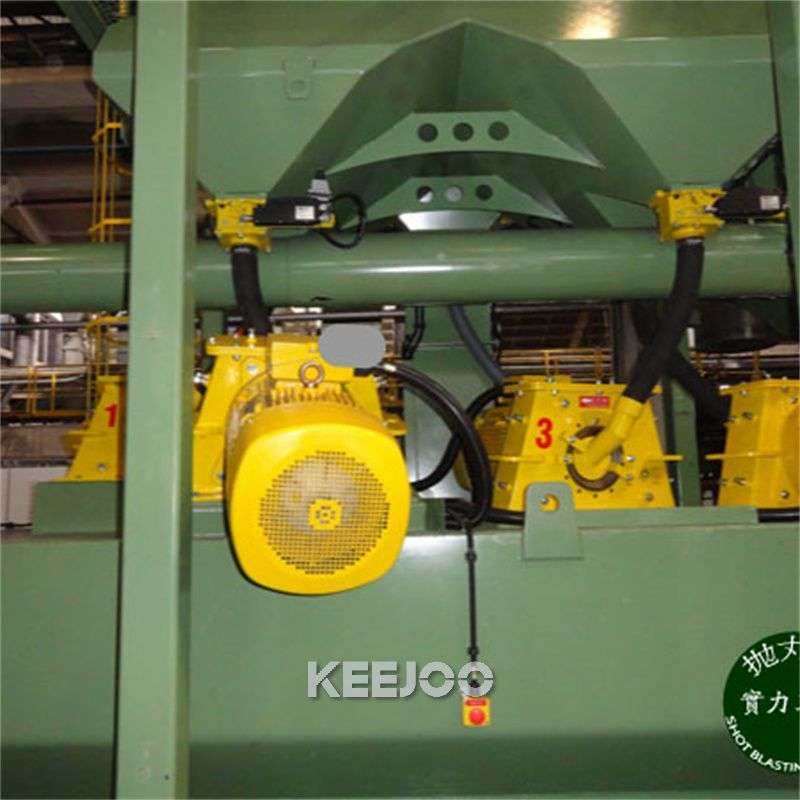
A shot blasting machine uses a motorized impeller (rotating at 2,000 to 3,000 rpm) to accelerate steel or cast iron shot to speeds ranging from 60 to 100 m/s (approximately 216 to 360 km/h), creating a dense stream of shot that impacts the workpiece.
II. Cleansing action: Physical removal and abrasion
Acting like countless tiny "steel hammers", the high-velocity pellets deliver a powerful impact and cutting effect on surface contaminants:
Breakdown of brittle contaminants: Mill scale, layers of rust, foundry sand, welding slag and other loosely bound contaminants are broken down and separated from the surface upon impact.
Micro-cutting and leveling: The pellets perform a microscopic cutting action on the base material, removing burrs, sharp edges and surface protrusions, resulting in a uniform surface roughness (typically Ra 3.2-6.3 µm).
Comprehensive Coverage: The fan-shaped shot stream is capable of cleaning difficult cavities, welds and hard-to-reach corners, demonstrating efficiency far superior to traditional acid etching or hand grinding methods.
III. Strengthening action: Surface plastic deformation and stress optimization
Simultaneously with the cleaning process, the impact of the shot causes controlled cold-deformation plastic deformation in the surface layer of the metal (to a depth of 0.1–0.5 mm), which leads to three main hardening effects:
Formation of deep residual compressive stresses
In the surface layer (extending to a depth of 0.3–0.5 mm), a layer of compressive stresses is formed, reaching values from -500 to -800 MPa. Function: This compressive stress compensates for tensile stresses arising during operation, prevents the initiation and propagation of fatigue cracks and, as a rule, increases the fatigue life of the part by 2–10 times.
Refining the granular structure of the surface
The grain size on the surface decreases from the initial range of 20–50 μm to 5–10 μm, which leads to the formation of a high-density dislocation network.
Function: This grinding increases surface hardness by 20–40% while improving the material's resistance to both wear and corrosion. Elimination of microdefects
Surface microcracks and pores are sealed, stress concentration is reduced and the risk of destruction is minimized in the early stages of operation.
IV. How is this achieved "simultaneously"?
Single process, double effect: The instantaneous impact of the pellets simultaneously provides “contaminant removal” (cleaning) and “surface deformation” (hardening), eliminating the need for multi-step processing.
Adjustable parameters - uncompromising quality: By varying parameters such as shot size, feed speed, flow rate and duration of exposure, it is possible to achieve the required intensity of hardening (level of residual stresses, depth of the hardened layer), while maintaining specific standards of surface cleanliness (for example, degree Sa2.5/3).